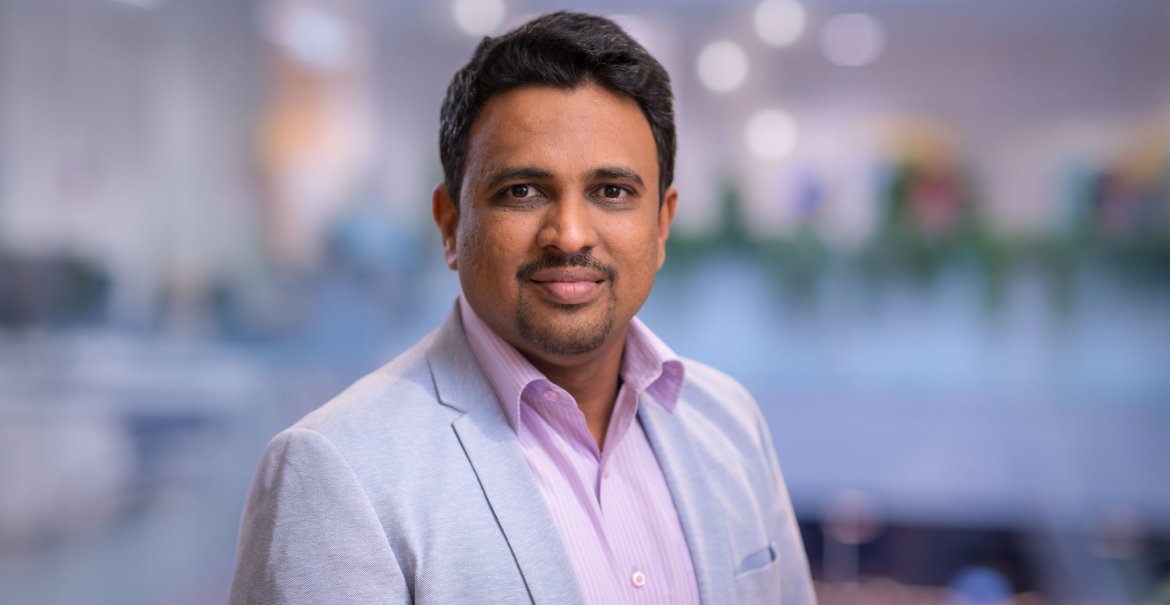
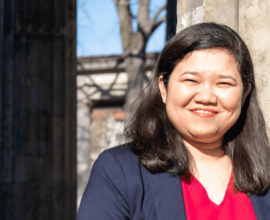
Rajasunath Gondi

Reading Time: 8 minutes

Rajasunath Gondi
MSc SCPM 2011
Eindhoven

Operations Director for Interventional Imaging Systems, Philips

Approaching his fortieth year, Rajasunath Gondi (MSc SCPM 11) is the Operations Director for Interventional Imaging Systems at Philips Eindhoven, in the Netherlands. Today at the helm of a staff of 3,500, his career trajectory has been marked by a series of bold decisions. Despite enjoying a comfortable job position, he resumed his studies opting to follow a double degree programme between Politecnico di Milano and Audencia in Nantes.

In 2011, thanks to this experience and his new academic qualification, he headed out to the Netherlands to work for Philips. Here, he has carved out a successful professional and a personal life for himself. His wife and two children, 1 and 4 years of age, constitute the pillars of support upon which Rajasunath Gondi can always rely.

Could you walk us through your career journey that took you from India to the Netherlands?

I grew up in Kerala, in southern India. After my school years, I enrolled on an engineering course at one of India’s most prestigious institutes: NIT-Warangal. This enabled me to join the graduate development programme at Whirlpool, in the electrical home appliance industry. This was my first taste of the professional world. Then, I was part of the merger we conducted. This paved the way for my first international role and my first-ever overseas trip.

Following this experience, I wished to open myself up to further professional opportunities by following a master’s in purchasing and supply chain management. I’d come from a technical background, yet I found positions that combined technical expertise and commercial skills appealing. This is how I came to join the double degree programme between Politecnico di Milano and Audencia in Nantes. This proved a tremendous experience: getting to live in Milan and then in Nantes. Two different cultures and two different experiences. In Milan, I lived in student lodgings, with a host of other international students. This experience was very rewarding thanks to the various cultures and ways of life I encountered. In Nantes, I lodged at an English teacher’s house who hosted students. She was just great. She helped me to settle into life as a non-French speaking student. On leaving Audencia, I landed an assignment at Valeo in Paris. Then, the Philips opportunity came my way shortly after this. I received the job offer letter from Philips, requesting me to make my way to the Netherlands for 11 May, 2011. And for the past 15 years, my career path has been with them.


Is there one decision in particular which particularly shaped your career path?

Every day you make decisions and each path is conducive to learning something new. However, I’ve always been of the opinion that the initial move you make is the most important for your confidence.

So, in my eyes, the biggest decision I’ve made was to go back to my studies despite having a career which was going very well at Whirlpool. The fact of going from a situation where I was making a very good living to resuming my studies really helped shape the person I have become.


Do you have any special recollections of your arrival in Europe?

It was in 2010. My plane landed on a Sunday, early in the morning, at Milan Malpensa Airport. It was chilly. At the time, I wasn’t aware that everything would be shut on a Sunday.  Leaving the airport, taking the tramway, then walking in the cold to find the hotel… It was 7 o’clock in the morning and the streets were all deserted. There was nobody for me to ask for directions. This proved a real eye-opener and a lesson in humility: I was now on my own.  In India, there are people you can communicate with at all times of the day. In Europe, people only speak if there’s a reason to do so. Looking back, this was a very good first experience.


What did you get out of the master’s degree you followed at Politecnico and Audencia?

The training corresponds to what I do now. I’m in operations, and my job revolves around the supply chain, purchasing, and manufacturing. I honed most of my skill set during my master’s degree course. This is the strong foundation on which I’ve gone on to build my career.

Moreover, I have further broadened my horizons thanks to encountering people from different backgrounds: with more experience, from other cultures, or meeting young students. I have kept in touch with part of this network even to this day. A while back, I visited two Malaysian friends of mine in Switzerland. We spent a few days in each other’s company. Whenever the opportunity arises, we try to get together. Then there’s also the Audencia Alumni network. When there are fairs or other events being put on, and whenever there are professional opportunities, there is always active communication.  And here, in the Netherlands, we have an Audencia Alumni Netherlands group, where there’s a steady flow of news and information. These relations are very enriching as they stand the test of time. There’s no need to speak on a daily basis, but whenever a need or an opportunity arises, we can count on this shared common ground.


You are at the head of operations for the range of interventional imaging systems at Philips (IGT Systems). Could you explain to us what this activity and your role involve?

This activity, aimed at medical professionals, is on the rise at Philips. We have several manufacturing sites for our interventional imaging systems. We have customers in over 200 countries and are market leaders in this field. Every second, we help in saving or treating a patient.

At my level, that’s to say on a global level, I am in charge of over 3,500 people. I am responsible for our end-to-end strategy and the execution for our IGT Systems activity. I supervise purchasing, planning, manufacturing, delivery, installation and customer services. I head up our global transformation that is aimed at promoting agility, resilience, and cost competitiveness by means of operational excellence, digital innovation, and network optimisation. I drive the activity’s growth by aligning business performance with that of the supply chain, while developing circular-economy and strategic partnership models within the value chain. The goal here is to improve outcomes for customers and patients alike. Hence, there is a true value creation dimension to the work I carry out. Yet, there is still much to learn, for AI generates a great deal of technological disruption, given the speed of innovation which stands to reshape the future. With this in mind, I feel both curious and enthusiastic as to the future.


What are the key skills you rely on?

Each day you learn something new and you grow as a person. One of my strengths is my ability to make a decision without the need for perfect data. I believe this is a good skill to have.

I also have a vision of where we need to go. When you bring this compass with you to the office, coupled with solid communication skills – a point on which I still have more to learn -, when you show up with resilience and can set an example when it comes to affirming direction, there’s no room for ambiguity to derail the objective.

Technology is taking the world by storm, so evidently the work I’ve learned over the past fifteen years won’t be the work I’ll be doing in the coming 12, 24, or 36 months ahead. This adaptability, whether cultural or technological, is a noble quality at a time when change is happening at lightning speed.

What’s your take on the major challenges facing your profession over the coming years?

I would rather see these as opportunities that we will have to create. The world has become much more fragmented. Gone are the days when you could have a global one-stop-shop for solutions. I firmly believe that we live in a regionalised world. We will be much closer to the customer in terms of the way we operate.

What’s more, the second thing I’m convinced of is the existence of disruptive technologies – not only AI -, and above all fast-paced disruption that we should be following. Leaders will see their agility and resilience being put to the test. Our role is in turning challenges into opportunities. The resilient supply chains, that have the right product in the right place in a global dynamic context, will have the winning proposal.


How would you describe the Dutch work culture?

It is built on a consensus culture. This involves a lot of conversations, with far more preparatory groundwork, and it takes longer to come to a decision.

Yet, that’s also the beauty of this culture. Once you understand this, you are able to navigate with the pace set by the results or by the demands of the post. It’s important to adapt. For instance, you can specify on the invite if the meeting is for the purposes of reaching a decision or to bring people up to speed. However, the culture is also very open and direct in the Netherlands and at Philips. This also means you can be crystal clear as to the objectives and deadlines you expect. I have learned to adjust to the particularities of the place in which I live.

And finally, change management becomes much easier since you have taken the time to listen to everyone. You have reached a consensus. At times, the decision may take longer, but implementing it goes more quickly. This is a compromise that works.


You brought up adaptability. Would you say your contact with different cultures has proved beneficial to you?

I sincerely believe that the curiosity of the individual plays a role. Clearly, experience and the fact of being exposed to different cultures facilitates understanding and your being understood. This all hinges on communication, whether through body language or the spoken word.

In France alone, between Nantes and Paris, you see a huge difference in the way people approach you, and in how they help you. This ability to understand, to adapt, and then to make yourself culturally understood, develops with each new experience. I’ve travelled a great deal since joining Philips, be that in China, Costa Rica, Indonesia, India, or throughout Europe, etc. Indeed, each experience teaches you something new about the country, and also yourself.


How did you go about building up a social network for yourself in the Netherlands?

The Netherlands is a very welcoming country and the culture is all about embracing diversity. So, I’m living my best life in the Netherlands. In terms of the work life here, it’s very professional. Through all the collaborations and teamwork, you get to grow your credibility and forge good relations.

Personal experiences, on the other hand, are quite unique. Firstly, there’s my natural affinity towards the Indian community, present in the Eindhoven region. The second network is linked to the international culture forming part of the Netherlands. And thirdly, all the local colleagues who have become friends of mine. This is the trickiest part, since they already have their own circle of friends, they made in early childhood. So, it took a long time to find the sweet spot, to cross the line between professional relations and a more personal friendship circle. However, I appreciate each of these personal experiences. They all have great merit.


What’s your everyday life like, between your native culture and the Dutch culture?

My wife is also of Indian culture. We try to keep our cultural origins alive, whilst also adapting to the country in which we live. We keep our culture alive in the home. We speak Telugu, and we celebrate Indian festivals. Yet, we also celebrate the King’s Day and Easter too. Our four-year-old son explains to us what happens on these days, just by what he experiences during class.

What I’ve adopted from the Dutch culture, is the fact of being open, transparent, and direct. I might likely find this difficult should I ever return to live in India, where there’s much more subtlety and diplomacy. This part of the culture really appeals to me, as this also matches my personality.


Is it hard to live far from your roots?

Do I miss India? Absolutely! I miss the support of my family. I miss my parents, and my sister and her family. I’d like to share more quality time with them. We try to get together as often as we possibly can, either by us going to visit them, or them coming to see us. However, this is a life choice I’ve made and I take full ownership.

How do you like to spend your free time?

I try to spend a lot of time with my children. They’re young and uplift me with their energy levels. I enjoy going for bike rides with them or simply being around them when they’re playing in the garden. My family’s positive energy, that of my wife and two children, as well as the blessing of having my parents, shows me that I’m in a lucky and privileged position. For my part, I also continue to do sport.
I’m fond of having a coffee and spending time with my friends. In the Indian culture, there’s no need for an appointment to go over to someone’s house for dinner. So, we drop in and make the most this quality time together.

You May Also Like

Ana Maria Olaya Vargas
A priceless taste of freedom

Elisabeth Gautier
Elisabeth and her thirst for learning

Marie Comacle
Breaking down taboos on female masturbation and sexuality

Esha Shrestha
A fascination for optimisation