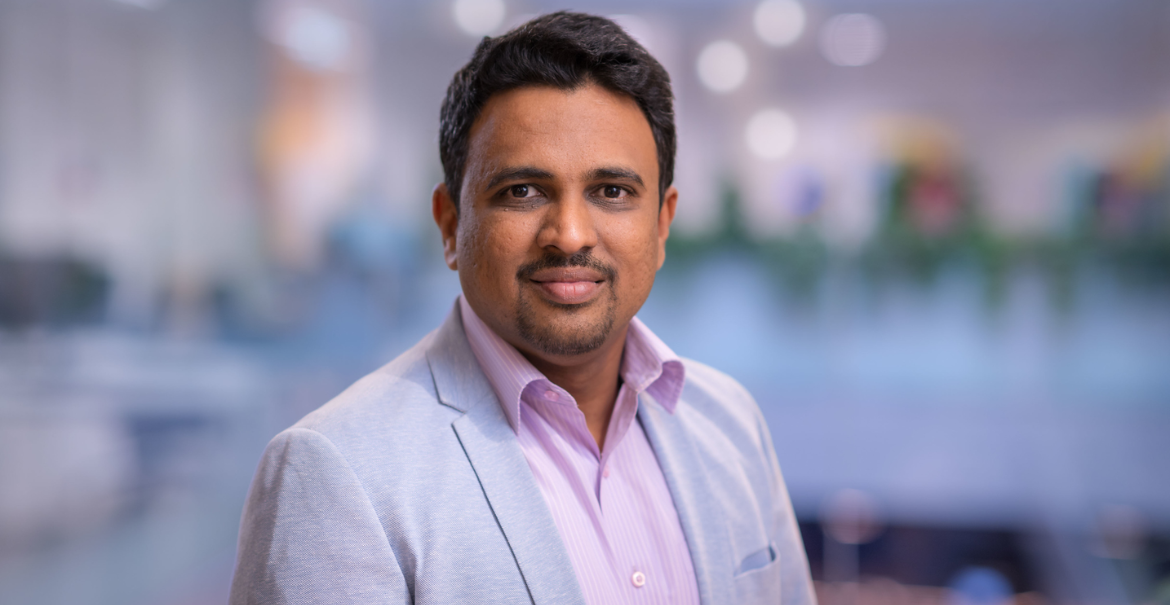
Rajasunath Gondi
Building a career without borders
 Reading Time: 7 minutes
SVP, Head of Integrated Supply Chain, Philips
From Kerala, via Milan and Nantes, to Eindhoven, Rajasunath (Raja) Gondi’s journey is one of reinvention, resilience and global leadership. Once his career was already under way, Raja’s bold decision to return to university became the launchpad for a global career in healthcare technology operations, opening the door to new cultures, perspectives and opportunities.
Today at Philips in the Netherlands, Raja brings together technical depth, cultural agility and supply chain leadership at scale, working to shape resilient, agile and responsible end-to-end supply chains for the future of healthcare technology.
Can you take us through your journey from India to the Netherlands?
I grew up in southern India, spending my school years in Kerala and my engineering in Warangal. Through my degree in engineering, I had a first taste of the professional world when I joined the graduate development programme at Whirlpool in India. This paved the way for my first international role.
It wasn’t soon before I began thinking about wider professional opportunities. As part of this new objective, I left India for Europe to study supply chain and purchasing management, first in Milan then in Nantes. This proved a tremendous experience in more ways than I could ever have imagined. Whether it was living in student digs with a host of other international students or renting a room at an English teacher’s house, these were two totally different but equally enriching European experiences. I then left Nantes for Paris before heading for Groningen to join Philips, and I have been there ever since!
Is there one decision that has shaped your career path?
Careers are rarely built in a straight line, and the defining move was not a promotion, but a deliberate pause. After my engineering degree and role with Whirlpool, the roles that excited me most sat at the intersection of technology, commerce and operations.
That insight led me back to the classroom and I chose the double-degree experience between Politecnico di Milano and Audencia, specialising in purchasing and supply chain management. Leaving a budding professional career to become a student again was, in my eyes, the defining decision that changed the direction of my career and really helped shape the person I have become.
Tell us about your experience and first impressions of arriving in Europe
I remember it well! It was back in 2010, when my plane landed in Milan early on a Sunday morning. It was quite chilly and I soon discovered that I hadn’t realised just how quiet Europe could be on a Sunday – everything was closed. I left the airport, took the tram and then walked through the cold to find my hotel. It was 7am, the streets were deserted, and there was no one around to ask for directions. It was a real eye-opener and a lesson in humility: I was now on my own.
Coming from India, where there are usually people around and someone to turn to at almost any time of day, I had to adapt to a very different way of life. In Europe, people tend to give you space and only engage when there is a reason to do so. Looking back, this was a very valuable first experience as it taught me to be more self-reliant, observant and open to a different culture, setting the tone for the journey ahead.
How have the relationships you built at Audencia and Politecnico di Milano stayed with you?
Encountering people from different backgrounds has certainly broadened my horizons, and many of the friendships I made back then have stood the test of time. I still keep in touch with friends from those years and, whenever the opportunity arises, we make time to reconnect.
Alumni network has also played an important role in maintaining these relationships. Whether through fairs, events or professional opportunities, there is always an active exchange of news and information. Here in the Netherlands, for example, we have an Audencia Alumni Netherlands group that keeps us connected and informed. What I find particularly enriching is that these relationships endure over time. We don’t need to speak every day; whenever a need, an opportunity or simply a chance to reconnect arises, there is a shared experience and common ground that brings us together.

How did the transition from the classroom back to the business go?
After graduating, I took an assignment at Valeo in Paris and shortly afterwards, Philips offered me a position in the Netherlands. More than a decade and a half later, Eindhoven has become home: the place where I have built a global career, a family life and a leadership style rooted in clarity, curiosity and resilience.
During my time at Philips, I have held several roles. Today I lead supply chain in medtech, an area where operational excellence has a direct link to clinical and customer impact. My remit spans strategy and execution across the end-to-end ecosystem, from purchasing, planning and manufacturing through to delivery, installation and customer service readiness. The scale is significant: a global operations engine, serving customers and patients around the world.
Leadership at this level is about remaining curious. My focus is to build supply chains that are more resilient, agile, digital and customer-focused, while supporting growth and competitiveness. I am also committed to stronger partnerships and circular-economy models across the value chain, creating value for the business, healthcare customers and patients.
In a changing world, the strongest supply chains place the right product in the right place, at the right time – with resilience, responsibility and velocity.
What key leadership skills matter to you?
I believe leadership is built through continuous learning. One of the skills I value most is the ability to decide without waiting for perfect information. In complex global operations, every decision contains uncertainty. A leader’s role is to provide direction, clarify the trade-offs and keep people focused on the outcome.
I also place a premium on communication, resilience and adaptability. These are no longer “soft” skills; they are operating requirements in a world where technology, geopolitics and customer expectations are shifting at speed. The work learned over the past 15 years will not be enough for the next 12, 24 or 36 months. Leaders must keep learning and remain curious.
Artificial intelligence and other digital technologies are part of that future. For me, the question is not whether technology will transform supply chains, but how leaders can use it responsibly to improve decision-making, strengthen resilience, bring velocity, and deliver better outcomes for customers and patients. Hence, there is a true value creation dimension to the work I carry out. Yet, there is still much to learn. AI generates a great deal of technological disruption, given the speed of innovation which stands to reshape the future. I feel both curious and enthusiastic as to the future.
How have you learned to lead across cultures?
Let’s go back to that first morning when I landed in Milan and came to realise that I had to navigate the moment by myself. That defining moment and lesson in humility, independence and adaptation has followed me throughout my career. I’ve lived and worked across India, Italy, France and the Netherlands, and I’ve travelled widely through Europe, Asia and the Americas. Each experience has sharpened my ability to listen, to understand, adjust and make myself understood across different cultural contexts.
The Dutch workplace has shaped me in a particular way. I would describe the working culture here as consensus-driven, open and direct. To a certain extent, you might think that decisions take longer here because people expect meaningful dialogue and meticulous preparation. However, once a decision has been made, implementation can be faster because alignment has been built. Change management also becomes easier since you’ve taken the time to listen to everyone.
How did you go about building connections and friendships for yourself in the Netherlands?
The Netherlands is a very welcoming country, and its culture places a strong value on diversity and inclusion. I’m living my best life here. Professionally, building connections has come quite naturally through collaboration and teamwork. By working closely with others, you build credibility, develop trust and, over time, forge strong relationships.
On a personal level, my experience has been shaped by three different overlapping circles. First, there is my natural affinity with the Indian community in the Eindhoven area. Then there is the broader international community, which is such an important part of life in the Netherlands. And finally, there are my Dutch colleagues who have become my friends.
That last step has perhaps been the most challenging as many of my Dutch colleagues have established friendship circles that go back to childhood, so finding your way into those circles takes time. It took me a while to find that sweet spot and to move beyond professional relationships to develop genuine personal friendships. But that is also what makes these connections so rewarding. Each circle has enriched my experience in a different way, and I truly value all of them.
Would you say your contact with different cultures has proved beneficial to you?
Life in the Netherlands has shaped me personally. At home, my family keeps Indian traditions alive. We speak Telugu and we celebrate Indian festivals, but we also embrace Dutch customs such as King’s Day and Easter. My children bring local traditions home from school and contribute to keeping our family life both rooted and open.
I’ve adopted the openness, transparency and directness of the Dutch culture. It’s the part that really appeals to me as it also matches my personality.
That’s not to say that I don’t miss India, especially time with my parents, sister and extended family, but living outside my home country was a conscious life choice and I take full ownership for that.
How do you like to spend your free time?
I try to spend as much time as possible with my children. They’re still young, and their energy and enthusiasm are incredibly uplifting. I enjoy going for bike rides with them or simply being around while they play in the garden. My family – my wife and two children – brings so much positive energy to my life. Together with the privilege of having my parents, they remind me how fortunate I am. I also make time for sport, which remains an important part of my life.
What would be your message for future generations of students at Audencia?
I would say that my own story is a reminder that studying for a degree is more than a credential. It can be a launchpad for newer perspectives and lifelong networks. For students and alumni, my message would be to make the bold move, stay curious, build capability across disciplines, and keep adapting without losing your roots.